
 Santa Cruz / Bolivia
SANTA CRUZ DE LA SIERRA CITY
The city of Santa Cruz de la Sierra, located in the eastern region of Bolivia, stands as one of the most dynamic and vibrant urban centers in the country. It lies within the vast Amazonian plains, in the department of Santa Cruz, at an average altitude of approximately 416 meters above sea level, granting it a warm tropical climate throughout most of the year. Geographically, it occupies a strategic position that connects the Andean highlands with the lowlands and the Amazon basin, establishing itself as a key hub of territorial integration.
Known as the “city of rings,” Santa Cruz de la Sierra is distinguished by its unique urban layout structured in concentric rings that organize and define its expansion. This design not only enhances mobility but also reflects the city’s continuous growth and development.
Over recent decades, Santa Cruz has become a major pole of migratory attraction, welcoming people from across Bolivia and beyond. This human diversity has shaped a dynamic, open, and ever-evolving society where cultures, traditions, and perspectives converge.
Furthermore, the city stands as a true land of continental integration. Its strategic location, combined with sustained economic growth and modernizing infrastructure, positions it as a vital link between neighboring countries and international markets. Santa Cruz de la Sierra is not only Bolivia’s economic engine but also a place where the meeting of routes, cultures, and opportunities defines its contemporary identity.
SAMAIPATA
Nestled in the foothills of the eastern Andes, the region of Samaipata emerges as a destination where nature and history converge with singular elegance. Located in the department of Santa Cruz, approximately 120 kilometers southwest of Santa Cruz de la Sierra, this charming town sits at an altitude of around 1,650 meters above sea level. Its privileged geographical setting, at the crossroads between temperate valleys and the Amazon basin, grants it a mild and pleasant climate throughout the year—ideal for both relaxation and exploration.
Samaipata is home to one of Bolivia’s greatest heritage treasures: El Fuerte de Samaipata, regarded as the country’s second most important archaeological site. This enigmatic pre-Hispanic complex, carved into a massive sandstone rock, preserves traces of ancient civilizations and reveals a past rich in symbolism, mystery, and spiritual significance.
Beyond its historical wealth, the region captivates with a diversity of experiences. Its high-altitude vineyards, cultivated under exceptional conditions, produce wines of distinctive character that reflect the identity of the terroir. Likewise, conservation spaces such as a charming hummingbird sanctuary invite visitors into a delicate world of color and movement, where these tiny birds display their extraordinary beauty.
Samaipata thus presents itself as a haven of serenity and natural sophistication—a place where landscapes, cultures, and sensations intertwine, offering a more intimate, authentic, and deeply captivating vision of Bolivia.
JESUIT MISSIONS OF CHIQUITOS
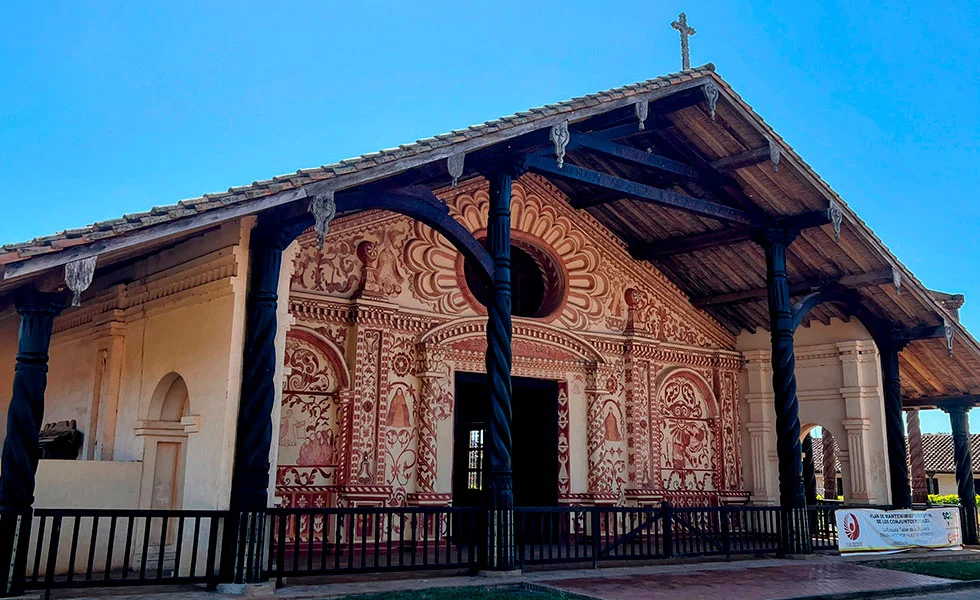
In the heart of eastern Bolivia, stretching across the vast plains of the Santa Cruz Department, the Jesuit Missions of Chiquitos emerge as a living legacy of faith, art, and cultural encounter. This region, situated between 200 and 400 meters above sea level, enjoys a warm tropical climate and an open geography that connects the Chiquitano dry forests with ancient routes of continental integration.
The journey begins in the dynamic city of Santa Cruz de la Sierra, from where travelers set out eastward, crossing landscapes that reveal the transition between the urban and the ancestral. The first major stop is the mission of San Javier, considered the cradle of this extraordinary mission circuit. Its church, built in a mestizo baroque style, still preserves the spirit of the ancient Jesuit reductions.
Following the route, one reaches the majestic mission of Concepción, one of the most impressive of the ensemble, where artistic richness and musical tradition remain alive. In its surroundings, communities such as Santa Rita preserve their artisanal heritage, with skilled craftswomen safeguarding techniques passed down through generations.
The journey continues to San Ignacio de Velasco, a gateway to new heritage treasures. Its mission church, sober and elegant, reflects the adaptation of Jesuit style to local materials and sensibilities. From here, the route leads into a more intimate circuit, revealing the missions of San Miguel, San Rafael, and Santa Ana—small yet deeply authentic places where time seems to flow with the rhythm of past centuries.
Finally, the journey reaches the imposing mission of San José de Chiquitos, unique for its stone construction, whose monumental architecture stands as a lasting testimony to the encounter between the European world and indigenous cultures.
All these churches form part of a UNESCO World Heritage ensemble recognized by the UNESCO, highlighting their outstanding universal value. Within this exceptional setting, the prestigious Festival Internacional de Música Renacentista y Barroca Americana “Misiones de Chiquitos” comes to life each year, transforming the region into a grand musical stage. During the festival, the mission churches resonate with harmony and emotion, welcoming distinguished baroque musicians from around the world—especially from Europe—who find in this historic environment a unique acoustic and atmosphere.
Exploring the Jesuit Missions of Chiquitos is to embark on a journey where history, spirituality, and art intertwine at every step, offering a profound, elegant, and truly unforgettable experience in the heart of Bolivia.

 English
  Spanish
  French